Results gallery
Real output from real machines. Each directory holds exactly what llama-roofline run
writes: roofline.json (machine-readable), report.txt (the terminal report card),
report.md (shareable), and roofline.png.
Two devices at opposite ends of the range are included here. If you run the tool, please add yours: open an issue with the "Results gallery" template. Hardware I do not own is the most useful thing anyone can contribute, and results that disagree with the model are more interesting than results that confirm it.
| device | memory | models | ceiling | fitted BW_eff | R² | utilisation | verdict |
|---|---|---|---|---|---|---|---|
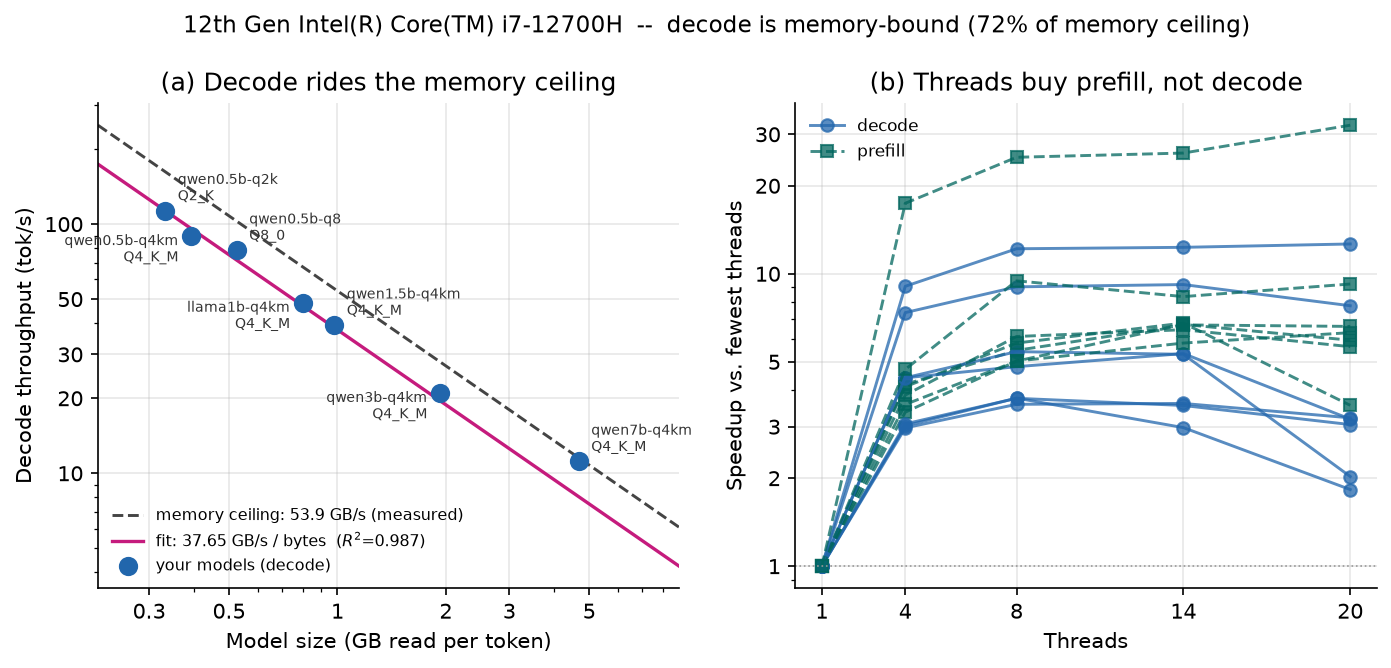
| Intel i7-12700H | DDR5-4800, 34 GB | 7 (0.5B to 7B) | 53.9 GB/s | 37.65 GB/s | 0.987 | 65-97% | memory-bound |
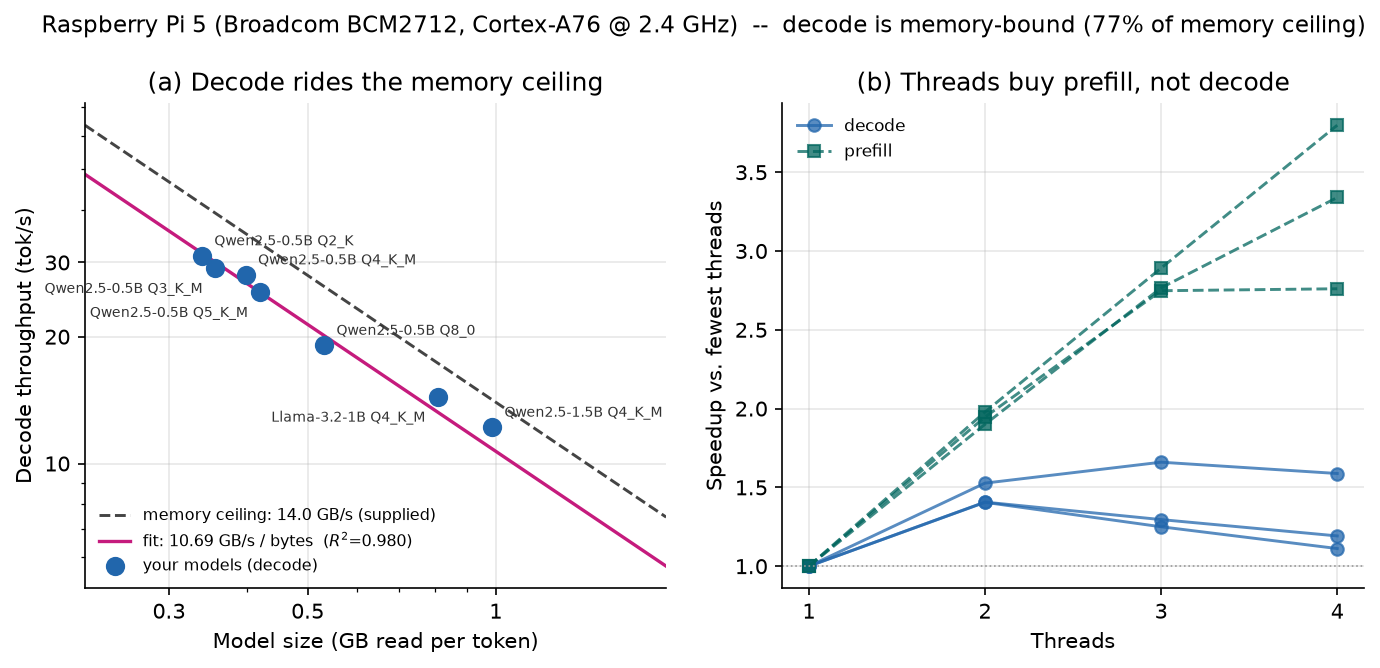
| Raspberry Pi 5 (Cortex-A76) | LPDDR4X, 2 GB | 7 (0.5B to 1.5B) | 13.98 GB/s | 10.69 GB/s | 0.980 | 73-86% | memory-bound |
The two machines differ by 3.5x in fitted bandwidth and by roughly 20x in price, and both
land in the same place: decode sits between 65% and 97% of the memory ceiling, and
throughput tracks 1/model_bytes with an R² above 0.98. That is the point of the tool.
The roofline is not a property of any one device.
Two details worth reading off these:
- On the laptop the largest model runs closest to the wall (the 7B at 97% of ceiling, the 0.5B Q4 at 65%). Bigger working sets stream more efficiently and amortise the per-token overhead that is not weight traffic.
- Using every hardware thread is a trap on both machines. On the laptop,
-t 20cost up to 63% of decode throughput versus-t 8. On the Pi, using all 4 cores cost up to 21% versus 2. Prefill, meanwhile, kept scaling in both cases.
About the Raspberry Pi 5 numbers
These were not produced by running llama-roofline on the Pi. They are the raw
llama-bench measurements from the study this tool grew out of, re-expressed in the
tool's schema and re-analysed by the tool's own code, using
rpi5-cortex-a76/convert_paper_data.py. Read the
docstring at the top of that script for the full provenance note; the differences from a
native run (file size instead of model_size for bytes-per-token, an externally supplied
bandwidth ceiling) are recorded in the results JSON and printed in the report's caveats.
The conversion is also a correctness check: handed the study's raw data, the tool recovers the published fit of 10.69 GB/s at R² = 0.980 over 7 points, exactly.
Reproducing these
# x86 example
llama-roofline run --models /path/to/models --threads 1,4,8,14,20 --reps 3

# Pi 5 example, from the published data
cd examples/rpi5-cortex-a76
python convert_paper_data.py /path/to/edge-llm/results
rpi5-cortex-a76
Terminal report
========================================================================
  llama-roofline v0.1.0  --  report card
========================================================================
  Machine   : Raspberry Pi 5 (Broadcom BCM2712, Cortex-A76 @ 2.4 GHz)
              4 logical / 4 physical cores, 2.0 GB RAM, Linux aarch64
  Memory    : 14.0 GB/s (external STREAM-style read benchmark for this board)
  llama.cpp : build ?, backends: CPU

  IS YOUR DECODE MEMORY-BOUND?
------------------------------------------------------------------------
  YES -- your decode is memory-bandwidth-bound.

  Token generation is running at 77% of the memory bandwidth this
  machine can actually sustain. The CPU spends most of each token
  waiting for weights to arrive from RAM, not computing.

  THE ROOFLINE
------------------------------------------------------------------------
    decode tok/s  =  10.69 GB/s  /  model bytes
    fitted across 7 models, R^2 = 0.9800,
    taking each model at its own best thread count
    that effective bandwidth is 76% of your 14.0 GB/s ceiling
    A fit this tight means one number -- bytes -- predicts your
    generation speed. You can size a model for a target tok/s.

  WHAT TO DO ABOUT IT
------------------------------------------------------------------------
  * Model size is your throughput dial. Halving the bytes you load
    roughly doubles tok/s: a smaller model or a lower quant buys speed
    almost exactly in proportion to the bytes it removes.
  * Measured on your models: Qwen2.5-0.5B Q2_K is 2.91x smaller than
    Qwen2.5-1.5B Q4_K_M and decodes 2.55x faster. Bytes in, tokens out.
  * Best decode thread count: 2. Past that, extra threads add
    contention, not throughput: decode is waiting on memory, and more
    waiters do not make the memory faster.
  * Using every thread cost up to 21% of decode throughput versus the
    best setting. Set -t explicitly; do not let it default.
  * Prefill is different: it scaled 3.3x with threads (median across
    your models). Prompt processing is compute-bound, so long-prompt
    workloads DO want all your cores even though generation does not.

  YOUR MODELS
------------------------------------------------------------------------
  model                     quant         size    decode   prefill  thr    GB/s  %ceil
  ------------------------------------------------------------------------------------
  Qwen2.5-0.5B Q2_K         Q2_K        339 MB     31.1t      148t    4    10.5    75%
  Qwen2.5-0.5B Q3_K_M       Q3_K_M      355 MB     29.1t      197t    4    10.4    74%
  Qwen2.5-0.5B Q4_K_M       Q4_K_M      398 MB     28.1t       89t    3    11.2    80%
  Qwen2.5-0.5B Q5_K_M       Q5_K_M      420 MB     25.5t       79t    4    10.7    77%
  Qwen2.5-0.5B Q8_0         Q8_0        531 MB     19.1t      249t    4    10.1    73%
  Llama-3.2-1B Q4_K_M       Q4_K_M      808 MB     14.4t       62t    2    11.6    83%
  Qwen2.5-1.5B Q4_K_M       Q4_K_M      986 MB     12.2t       55t    2    12.0    86%

  CAVEATS
------------------------------------------------------------------------
  ! converted data: measurements come from the published Raspberry Pi 5
    study, not from a native llama-roofline run. Bytes-per-token uses
    the GGUF file size rather than llama-bench's model_size, so
    utilisation reads ~1-2% high. See convert_paper_data.py for the full
    provenance note.
  * bytes-per-token is taken as the model's resident size. That is exact
    for a dense transformer at short context and an overestimate once
    the KV cache grows large, or for MoE models.
  * The ceiling was supplied rather than measured by this tool, so every
    percentage here is only as good as that number.
  * Numbers are throughput only. Nothing here measures output quality.

========================================================================
Files: convert_paper_data.py, report.md, report.txt, roofline.json, roofline.png

x86-i7-12700H
Terminal report
========================================================================
  llama-roofline v0.1.0  --  report card
========================================================================
  Machine   : 12th Gen Intel(R) Core(TM) i7-12700H
              20 logical / 14 physical cores, 34.0 GB RAM, Windows AMD64
  Memory    : 53.9 GB/s sustained read (measured: dot kernel, 10 threads, 512 MB set)
  llama.cpp : build 10154 (0e4a03622), backends: CPU

  IS YOUR DECODE MEMORY-BOUND?
------------------------------------------------------------------------
  YES -- your decode is memory-bandwidth-bound.

  Token generation is running at 72% of the memory bandwidth this
  machine can actually sustain. The CPU spends most of each token
  waiting for weights to arrive from RAM, not computing.

  THE ROOFLINE
------------------------------------------------------------------------
    decode tok/s  =  37.65 GB/s  /  model bytes
    fitted across 7 models, R^2 = 0.9874,
    taking each model at its own best thread count
    that effective bandwidth is 70% of your 53.9 GB/s ceiling
    A fit this tight means one number -- bytes -- predicts your
    generation speed. You can size a model for a target tok/s.

  WHAT TO DO ABOUT IT
------------------------------------------------------------------------
  * Model size is your throughput dial. Halving the bytes you load
    roughly doubles tok/s: a smaller model or a lower quant buys speed
    almost exactly in proportion to the bytes it removes.
  * Measured on your models: qwen0.5b-q2k is 14.06x smaller than
    qwen7b-q4km and decodes 10.15x faster. Bytes in, tokens out.
  * Best decode thread count: 8. Past that, extra threads add
    contention, not throughput: decode is waiting on memory, and more
    waiters do not make the memory faster.
  * Using every thread cost up to 63% of decode throughput versus the
    best setting. Set -t explicitly; do not let it default.
  * Prefill is different: it scaled 6.7x with threads (median across
    your models). Prompt processing is compute-bound, so long-prompt
    workloads DO want all your cores even though generation does not.

  YOUR MODELS
------------------------------------------------------------------------
  model                     quant         size    decode   prefill  thr    GB/s  %ceil
  ------------------------------------------------------------------------------------
  qwen0.5b-q2k              Q2_K        333 MB    113.3t      517t    8    37.7    70%
  qwen0.5b-q4km             Q4_K_M      392 MB     89.3t      351t    8    35.0    65%
  qwen0.5b-q8               Q8_0        525 MB     78.6t      294t   14    41.3    76%
  llama1b-q4km              Q4_K_M      800 MB     48.2t      245t   14    38.6    72%
  qwen1.5b-q4km             Q4_K_M      980 MB     39.3t      179t   14    38.5    71%
  qwen3b-q4km               Q4_K_M     1.92 GB     21.0t       87t    8    40.3    75%
  qwen7b-q4km               Q4_K_M     4.68 GB     11.2t       42t   20    52.2    97%

  CAVEATS
------------------------------------------------------------------------
  * bytes-per-token is taken as the model's resident size. That is exact
    for a dense transformer at short context and an overestimate once
    the KV cache grows large, or for MoE models.
  * The ceiling is what this machine sustained under a portable
    microbenchmark, not the spec sheet number. It is a floor on the
    truth, so the percentages are conservative.
  * Numbers are throughput only. Nothing here measures output quality.

========================================================================
Files: report.md, report.txt, roofline.json, roofline.png
