//Research
Measured, not simulated.
An independent research program on edge and embedded machine-learning systems: 13 papers measured on Arm Cortex-A76 and x86 silicon with hardware performance counters and on-board power instrumentation, 11 currently under review.
- Papers
- 13
- Under review
- 11
- Venues
- 9
- Since
- Jul 2026
The claim
The memory wall, not compute, governs deep-neural-network inference on real hardware.
One physical idea carried across scales: from mobile CNNs, to Vision Transformers, to on-device language models, measured on Arm and revalidated on x86, and next headed for enterprise servers. Every headline number comes from real silicon, using hardware performance counters and on-board power instrumentation. Each paper reports what the data supports, negative results and the regimes where a method does not help included, and ships the data and harness so any number can be rechecked.
What the measurements actually look like.
Ten configurations across an Arm SBC and an x86 laptop, plotted from the public artifact. Each machine's measured memory bandwidth draws a ceiling, and decode runs right underneath it on both.
Ten measured configurations, 339 MB to 4.7 GB, each at its best thread count. The dashed lines are each machine's measured peak memory read bandwidth, not a spec sheet figure. Decode lands at 80 to 86 percent of peak on the Pi and 81 to 96 percent on the laptop. The 7B point reads at 107 percent, which means the peak benchmark slightly understates what the memory system delivers under this access pattern, and it is left in rather than trimmed. Throughput here is set by how fast the machine can read the weights, not by how fast it can multiply.
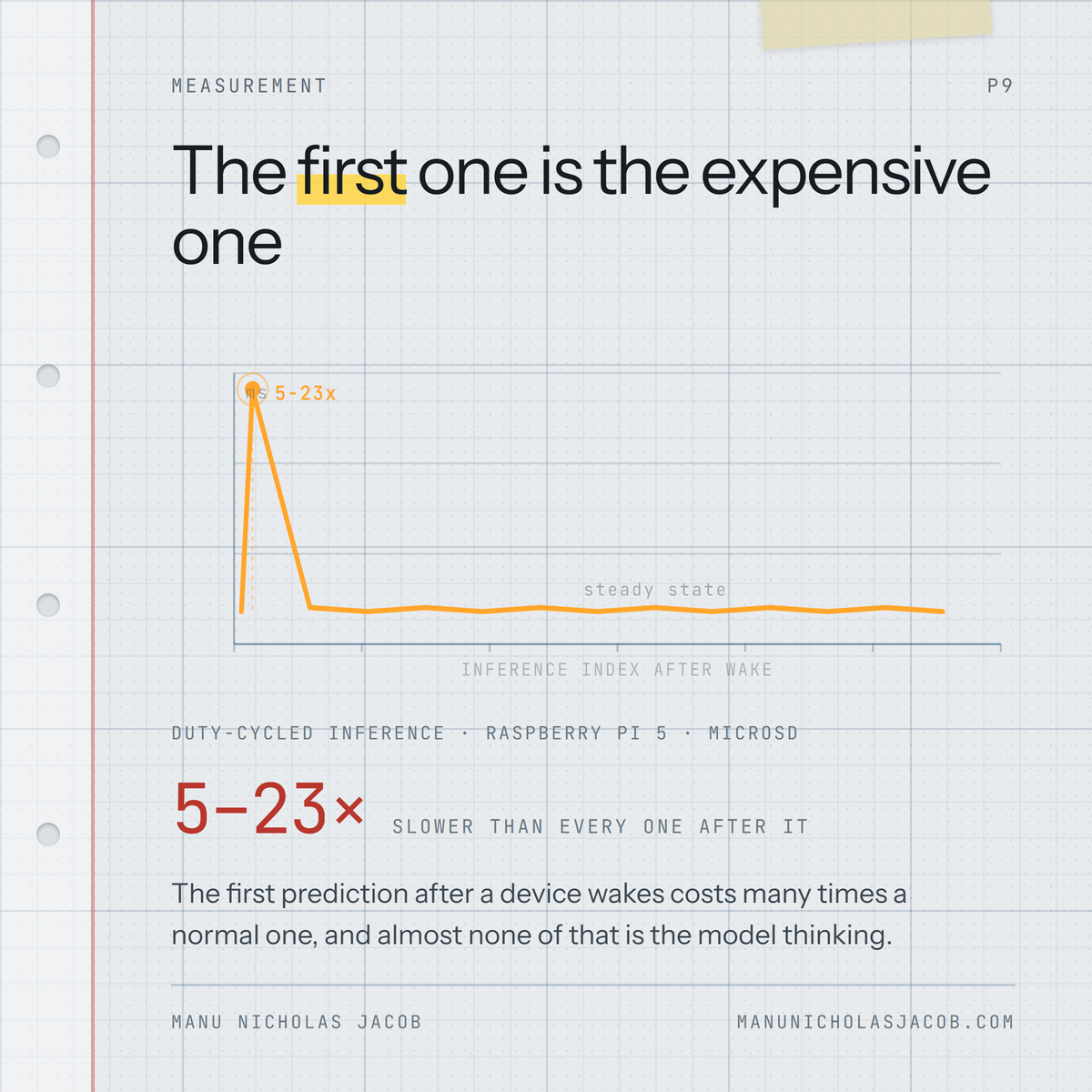
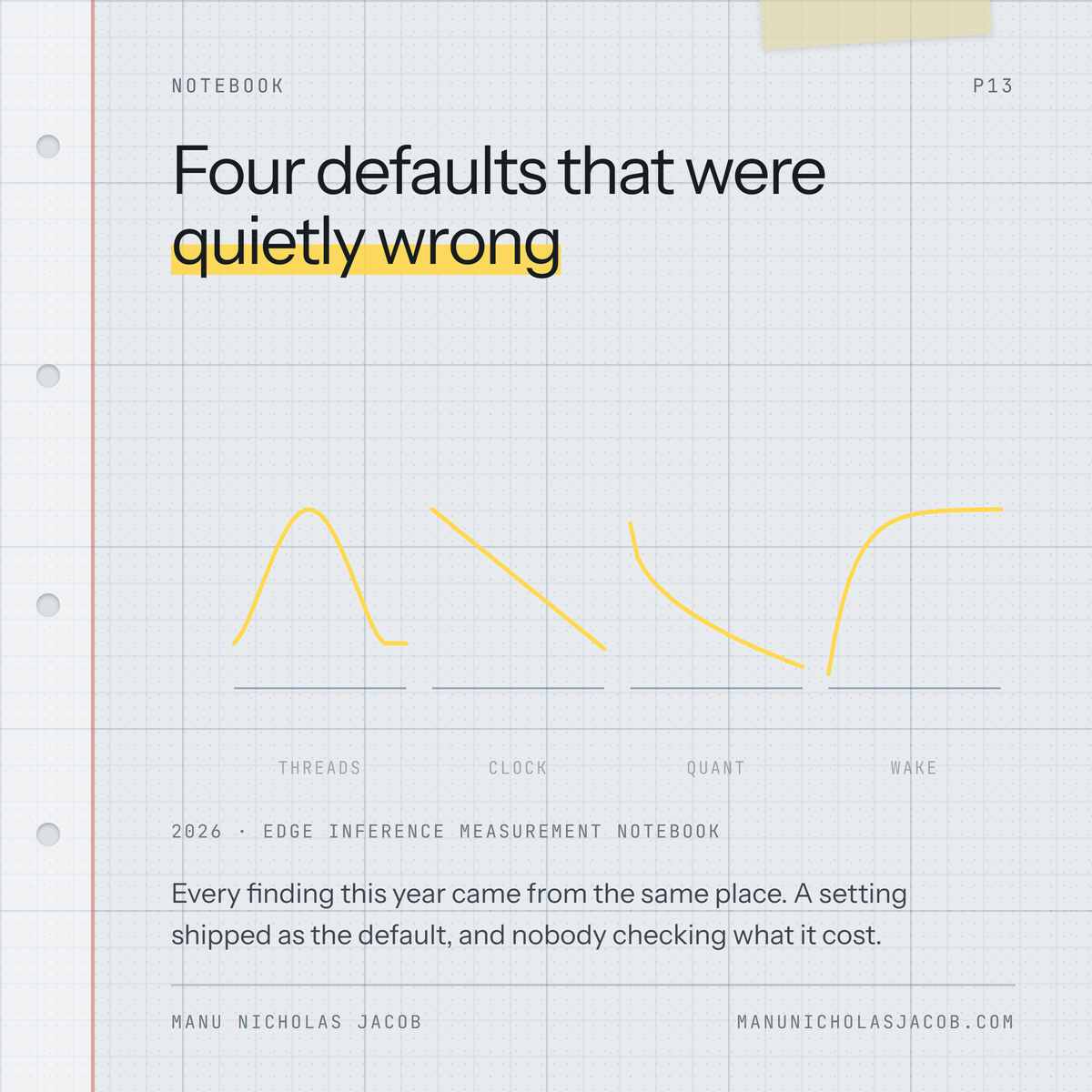
Two of the findings, as they left the bench
Publications · 13
- 01
The Memory Wall Governs Edge DNN Inference
Thread scaling, multi-tenant interference and INT8 speedups are not three separate phenomena. All three fall out of a single measured bandwidth ceiling.
20.5% leave-one-model-out prediction error across 9 CNNs and a ViT
RooflineMemory bandwidthCortex-A76ACM Transactions on Embedded Computing Systems
Journal
Under review
Submitted 28 Jul 2026
- 02
The Cold-Start Tax
The first systematic characterisation of the duty-cycled wake transient on an edge SBC. The tax is weight-loading-bound, predictable from model size alone, and falls off an eviction cliff. Includes GD-Tax, a tax-aware cache that beats LRU and LFU.
5x to 23x wake tax, R^2 = 1.00 loading-bound fit, >80x blow-up past eviction
Duty cyclingCache policyGD-Tax› Cite
@software{jacob_cold_start_2026, author = {Jacob, Manu Nicholas}, title = {The Cold-Start Tax}, year = {2026}, doi = {10.5281/zenodo.21844857}, url = {https://doi.org/10.5281/zenodo.21844857} }IEEE Internet of Things Journal
Journal
Under review
Submitted 6 Aug 2026
- 03
The Narrow Regime of Thermal-Aware Anytime Inference
Anytime inference is widely proposed for thermally constrained edge devices. This maps the narrow regime in which exit selection affects temperature at all, and shows quantization compresses the exit ladder enough to shrink the authority of the controller.
Quantization compresses the exit ladder from 20.6x to 6.9x
Anytime inferenceSLOThermalVenue in selection
Journal
In rebuild
Rebuilt around a measured state-of-the-art baseline
- 04
Four Walls Before Hello: Deploying LLMs at the Edge
A deployment guide rather than a new measurement: the four limits that decide whether an on-device language model is viable at all, drawn together from the bandwidth, cold-start, quantization and energy results and written for people shipping hardware.
Synthesises four measurement papers into one deployment guide
LLM inferenceEdge deploymentInvited special issueIEEE Design & Test
Journal
Under review
Submitted 17 Aug 2026
- 05
The Cold-Start Tax at the Edge of Language
The wake transient for on-device LLMs, where the model is 50 to 100x larger than a CNN. A phase-level decomposition shows about a fifth of the tax is the loader rather than the storage device, and a purpose-built loader recovers it.
A fifth of the LLM wake tax is software, and a better loader wins it back
LLM inferenceDuty cyclingStorageACM Transactions on Embedded Computing Systems
Journal
Under review
Submitted 17 Aug 2026
- 06
When Does INT8 Actually Pay on an Edge CPU?
Post-training INT8 measured across three microarchitectures on Arm and x86. The dominant effect is dynamic versus static quantization, worth about a factor of four; once both are produced statically, the export representation everyone argues about is worth a median of 1.5% across 27 model and core pairs.
Dynamic vs static: about 4x. The representation: a median 1.5%
QuantizationCross-platformONNX RuntimeIEEE Embedded Systems Letters
Letters
Under review
Submitted 17 Aug 2026
- 07
CPU Utilization as a Software-Only Thermal Proxy
A cross-validated CPU-temperature coupling law that needs no extra sensors, released with an open 13-hour telemetry dataset so others can re-run it.
Open 13-hour telemetry dataset, no added hardware
ThermalTelemetryOpen dataset› Cite
@software{jacob_thermal_proxy_2026, author = {Jacob, Manu Nicholas}, title = {CPU Utilization as a Software-Only Thermal Proxy}, year = {2026}, doi = {10.5281/zenodo.21844859}, url = {https://doi.org/10.5281/zenodo.21844859} }IEEE Embedded Systems Letters
Letters
Under review
Revised and resubmitted 5 Sep 2026
- 08
The Break-Even Parallel Speedup
Running inference on every core is the default on edge CPUs. Whether it saves energy turns on the parallel speedup against the power ratio, and on whether the static power of the board is charged to the inference. Measured on a Raspberry Pi 5 with the static floor measured at every operating point.
Break-even depends on what you charge to the inference
EnergyMultithreadingParallelism› Cite
@software{jacob_break_even_2026, author = {Jacob, Manu Nicholas}, title = {The Break-Even Parallel Speedup}, year = {2026}, doi = {10.5281/zenodo.21987261}, url = {https://doi.org/10.5281/zenodo.21987261} }IEEE Transactions on Computers
Journal
Under review
Resubmitted as a regular paper 6 Sep 2026
- 09
One Law, Two Memory Systems
The bandwidth ceiling that governs CNN inference governs on-device LLM decode too, and the KV cache turns it into a hard capacity wall. The same law holds on x86 at three times the bandwidth, so the same one-line roofline transfers between the two CPUs measured.
Decode roofline R^2 = 0.98, unchanged on x86 at three times the bandwidth
LLM inferenceKV cachellama.cpp› Cite
@software{jacob_edge_llm_2026, author = {Jacob, Manu Nicholas}, title = {One Law, Two Memory Systems}, year = {2026}, doi = {10.5281/zenodo.21844855}, url = {https://doi.org/10.5281/zenodo.21844855} }IEEE Internet of Things Journal
Journal
Under review
Rebuilt after the TC decline, submitted 22 Sep 2026
- 10
Your Quantization Format Is Not Free
Controlled measurements of GGUF quantization formats on three CPU microarchitectures. At small model sizes a format label predicts poorly what the file actually contains, and the community-default format pays a measurable cost. Full numbers after the review concludes.
What a format label does and does not tell you
QuantizationGGUFEnergy› Cite
@software{jacob_format_tax_2027, author = {Jacob, Manu Nicholas}, title = {Your Quantization Format Is Not Free}, year = {2027}, doi = {10.5281/zenodo.21938812}, url = {https://doi.org/10.5281/zenodo.21938812} }HotMobile 2027
Workshop
Under review
Submitted 22 Sep 2026
- 11
Use More Threads, Not Fewer
LLM decode thread scaling measured on a hybrid-core i7-12700H and a Raspberry Pi 5. Oversubscription costs predictability rather than speed, and a controlled headroom experiment names the cause. Extends and revises the Letter-length version a reviewer asked to see grown up.
Oversubscription costs predictability, not throughput
LLM inferenceHybrid coresSchedulingIEEE Trans. on Parallel and Distributed Systems
Journal
Under review
Extended after the CAL decline, submitted 23 Sep 2026
- 12
When Thermal-Margin Control Helps and When It Hurts
An honest operating-regime study of convex thermal allocation for multi-tenant edge inference, including the regimes where the controller is the wrong answer.
Maps the regime boundary rather than claiming a universal win
ThermalControlMulti-tenant› Cite
@software{jacob_thermal_margin_2026, author = {Jacob, Manu Nicholas}, title = {When Thermal-Margin Control Helps and When It Hurts}, year = {2026}, doi = {10.5281/zenodo.21844861}, url = {https://doi.org/10.5281/zenodo.21844861} }Venue in selection
Journal
Being re-homed
Rebuilt with matched baselines; returned on scope 10 Oct 2026
- 13
Latency-Optimal Is Not Energy-Optimal
Running an edge SBC at maximum clock wastes roughly a fifth of the energy per inference, and the waste is core-stall energy rather than DRAM energy. That reverses the usual intuition.
~20% energy wasted at max clock, with a deployable clock-selection policy
EnergyDVFSPower telemetrySustainable Computing: Informatics and Systems
Journal
Under review
Declined at ACM TECS, resubmitted 27 Sep 2026
Statuses are kept current by hand and papers are listed in submission order.